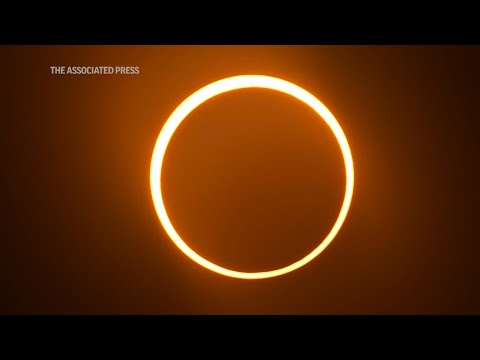
> View of total solar eclipse through NASA telescope
View of total solar eclipse through NASA telescope
Clip ID 2292632
Clearance
Add to
Share
Add to Review Link
By Request
By Request assets are not available for immediate purchase.
This content has not been pre-checked for copyright.
Per clip rates are for 20 seconds of final usage. If you are using more then 20 seconds or need a different file format or have questions about clearances contact us
Description
The total solar eclipse on Monday is expected to bring thousands of people to Ohio, where many major cities sit in the direct path of totality.
The last time the state has seen a total eclipse like this was in 1806, making this a once-in-a-lifetime event.
While the path of totality covers much of northern Ohio, areas of central Ohio may be able to catch the brief moments of total darkness, while others will see the sun at least 95% blocked by the moon.
Ohio will begin to see the partial eclipse just before 2 p.m. and it will end around 4:30 p.m. The total solar eclipse will begin around 3:10 p.m. for several communities and end around 3:14 p.m. with a maximum viewing time in Ohio just under four minutes.
Depending on where you are in Ohio, the start and end times will vary slightly.
Cleveland is one of the best places in Ohio to view the eclipse as it lies close to the center line in the path of totality and will spend nearly four minutes in darkness. Totality will begin there around 3:13 p.m. and end around 3:17 p.m.
In Toledo, totality begins at 3:11 p.m. and ends at 3:13 p.m. Dayton will see totality from 3:09 p.m. to 3:12 p.m.
While Columbus does not sit in the direct path of totality, it will still see the sun blocked about 99% of the way by the moon. The partial eclipse will start in Columbus at 1:55 p.m. and end at 4:26 p.m. The maximum eclipse can be viewed at 3:12 p.m.