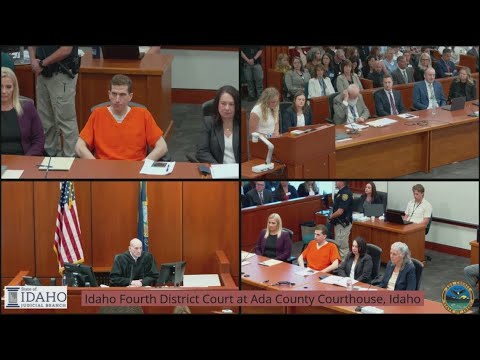
> Judge sentences Bryan Kohberger to life in prison for murdering four University of Idaho students
Judge sentences Bryan Kohberger to life in prison for murdering four University of Idaho students
Clip ID 2555918
Clearance
Add to
Share
Add to Review Link
By Request
By Request assets are not available for immediate purchase.
This content has not been pre-checked for copyright.
Per clip rates are for 20 seconds of final usage. If you are using more then 20 seconds or need a different file format or have questions about clearances contact us
Description
Bryan Kohberger, the masked man who sneaked into a rental home near the University of Idaho campus and stabbed four students to death in late 2022, faced the families of his victims in court Wednesday before he was sentenced to life in prison.
Whether those families will get any answers about why he did it or how he came to target the home on King Road in Moscow remains to be seen. But Kohberger, 30, was sentenced to life in prison for murdering Madison Mogen, Xana Kernodle, Kaylee Goncalves and Ethan Chapin in the rural college town of Moscow.
He pleaded guilty earlier this month in a deal to avoid the death penalty. He has an opportunity to speak at the sentencing — as do the loved ones of his victims.
Here's what to know about Kohberger's sentencing.
A plea deal was reached before a trial
Mogen, Kernodle, Goncalves and Chapin were found stabbed to death on Nov. 13, 2022. The crime horrified the city, which hadn't seen a homicide in about five years, and prompted a massive hunt for the perpetrator.
Kohberger, a graduate student in criminology at nearby Washington State University, was arrested in Pennsylvania, where his parents lived, roughly six weeks later.
Police said they recovered DNA from a knife sheath found at the home, and used genetic genealogy to identify Kohberger as a possible suspect. They accessed cellphone data to pinpoint his movements and used surveillance camera footage to help locate a white sedan that was seen repeatedly driving past the home on the night of the killings.
A Q-tip from the garbage at his parents’ house was used to match Kohberger’s DNA to genetic material from the sheath, investigators said.
Kohberger’s attorneys got the trial moved to Boise after expressing concerns that the court wouldn’t be able to find enough unbiased jurors in Moscow. But Judge Stephen Hippler rejected their efforts to get the death penalty taken off the table and to strike critical evidence — including the DNA — from being admitted in trial.
The trial had been set to begin next month.
In exchange for Kohberger admitting guilt and waiving his right to appeal, prosecutors agreed not to seek his execution. Instead, both sides agreed to recommend that he serve four consecutive life sentences without parole for the killings.
The victim's families were split on how they felt about the plea deal.
Kohberger's motive and many other details are unknown
If they know why Kohberger did it, investigators haven't said so publicly. Nor is it clear why he spared two roommates who were home at the time.
Cellphone location data did show Kohberger had been in the neighborhood multiple times before the attack.
Latah County Prosecutor Bill Thompson has said that Kohberger used his knowledge about forensic investigations to attempt to cover his tracks by deep cleaning his vehicle after the crime.
Police say Kohberger's Amazon purchase history shows he bought a military-style knife as well as the knife sheath found at the home. But the knife itself was never found.
The case drew widespread interest and judges feared the publicity could harm Kohberger's right to a fair trial. A sweeping gag order was imposed and hundreds of court documents were sealed from public view.
After Kohberger pleaded guilty, a coalition of news organizations including The Associated Press asked that the gag order be lifted and the documents be unsealed. Hippler agreed, but said unsealing the documents will take time and that process won't begin until after the sentencing hearing. It's not clear how many answers they might contain.