Description
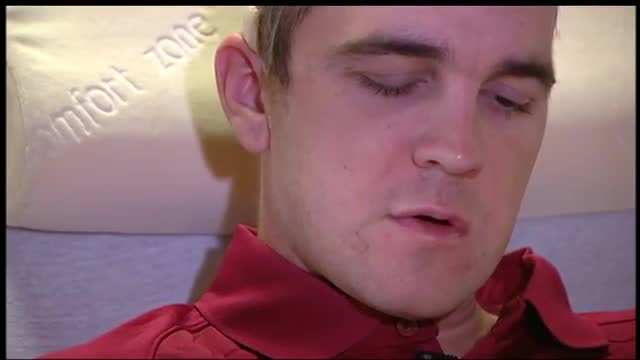
From the grimace on his face, you can easily see the pain of every small movement for Staff Sgt. Patrick Zeigler -- but you won't hear him complain.
Zeigler knows that the smallest of movements can mean the biggest of strides, and he's on a mission to walk again.
Zeigler is the only remaining victim from the Fort Hood shootings who is still hospitalized. He was shot four times.
I was shot in the right side of the head, in the left shoulder, left forearm, and left side of my hip; I think that's it.
He smiles in disbelief as he looks down at the scars on his arm. His recovery will take months, if not years.
Part of his skull is still missing, and two bullets remain lodged in his body.
The day we shot our story, Zeigler wanted to pause the videotape. One thing was out of place:His shirt. He wanted to wear a shirt showing his alma mater, Florida State University.
He sat on the rehab table and slowly changed. You could easily see a large bullet under the skin of his shoulder. He pointed it out, saying that it was safer to keep it there for now.
Zeigler is a shell of what he used to be. Much of his muscle mass has withered away. But his spirit, determination, and sarcasm are still intact.
From his photos, you can see a strong soldier -- a leader who always sported a mile-wide grin.
He was promoted to an E-6, a staff sergeant rank, in just four-and-a-half years with the Army. He joined after graduating from college saying that he had been moved by the 9/11 attacks.
On November 5, 2009, Zeigler was in the Soldier Readiness Center at Fort Hood to fill out paperwork. He had returned early from his second tour in Iraq after getting accepted into officer's candidate school, a process he started two years ago.
Staff Sgt. Ziegler was just five days away from that dream. That's when his life and his plans all changed.
Army investigators say Nidal Hasan, an Army major, walked into the center with two guns and plenty of ammunition. He loaded and unloaded, shooting the unsuspecting and unarmed soldiers in the room.
Thirteen people died that day; 38 others were injured.
Zeigler awoke in the hospital. His father and fiancee were both there.
It took me a few minutes to figure out where I was, Ziegler recalled. It didn't take me too long to figure out I was pretty messed up and it was pretty serious.
His family explained what had happened. He remembers much of the shooting, but won't talk about it. He and the other survivors are under a court order not to.
Zeigler soon decided that the new battle before him was one that he was going to win.
I moved on from there and started the process of accepting what happened and trying to realize what I was going to have to do, he said.
Since then, he's undergone intense therapy. His days are filled with one session after the next at a neuro rehab center in Austin.
Doctors had warned him that he may never gain control of his left arm, and walking could be a challenge as well.
Zeigler never believed it.
I still felt normal, he said. I still felt like myself. It didn't feel like I was completely shattered or totally broken.
Over the months that followed the shooting, he regained feeling in his legs and then slowly in his left arm.
When I first came here, I just flopped around and didn't have control of my body, he said.
That control is slowly coming back.
After his rehab session ended, we watched Zeigler walk back to his wheelchair. It was a short distance, but a major achievement, with his father, Pat Ziegler, by his side.
The elder Ziegler has been there since the shooting and he spends every day with his son. Pat Ziegler gave up his business near Greenville to do so.
The two men share more than a name -- they share determination.
You okay? Pat asked as he wheeled his son out of rehab. Yeah, Dad I'm good, Patrick said.
Staff Sgt. Zeigler underwent brain surgery in the days following our interview. He had part of a synthetic skull placed in his head, but the operation didn't go as planned.
Surgeons had to take the skull piece out after he had a terrible reaction. It's another setback -- and another hurdle -- for the wounded soldier to overcome.
Even so, Zeigler remains confident in one thing: I'm going to walk out of here.